


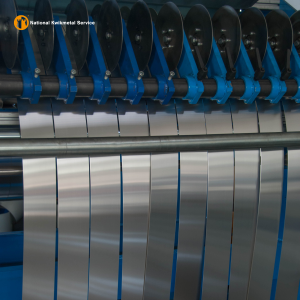
From electrical enclosures and brackets to formed channels and stamped components, many industrial products in the Chicago, Illinois market start as cold rolled steel coil. Cold rolled offers a cleaner surface and tighter dimensional consistency than hot rolled, which makes it a common choice when appearance, fit-up, and repeatable forming matter. But even the right grade can create downstream issues if the coil isn’t converted accurately. That’s where precision coil slitting comes in. National Kwikmetal Service (NKS) helps manufacturers convert cold rolled coil into job-ready widths that support smoother stamping, roll forming, and fabrication—without the schedule disruption that comes from width variation or poor edge condition.
Why Cold Rolled Steel Is a Shop-Floor Standard
Cold rolled steel is commonly selected when manufacturers need a combination of good formability, consistent thickness, and a smooth surface that supports finishing or appearance requirements. Those advantages show up in real production outcomes: more predictable forming behavior, cleaner bends, and improved repeatability in stamped features. To realize those benefits, coil conversion has to be controlled—because width variation and edge burrs can drive scrap, slow setups, and add risk to downstream assembly.
Commodity + Grade + Shape: Cold Rolled Steel Coil, Precision-Slit to Your Width
Cold rolled material typically enters your operation as master coil, then gets converted into narrower mults sized for your stamping dies, roll-form tooling, or brake forming plan. NKS supports industrial customers with precision slitting and cut-to-length options designed to deliver consistent widths, controlled edge condition, and repeatable coil-to-coil performance. The objective is simple: give your line the material it expects, so you can run longer, change over faster, and reduce avoidable scrap.
Application Focus: Stampings, Roll Formed Channels, Panels, and Industrial Components
Precision-slit cold rolled coil supports a wide range of industrial products, including stamped brackets and plates, roll formed channels and studs, cabinet and enclosure panels, HVAC accessories, and general sheet-metal components where fit-up and appearance matter. Because these parts are often produced in volume, small inconsistencies in incoming width or edge condition can compound quickly into downtime and scrap. Starting with correctly slit coil helps stamping and forming operations maintain stable runs and predictable part geometry.
How Slitting Quality Impacts Stamping and Forming Throughput
Slitting quality shows up immediately on the floor. Burrs and rough edges can create handling issues, accelerate tool wear, and drive inconsistent formed features. Width variation can force extra setup time, changeover adjustments, or part-to-part dimensional drift. For roll forming, stable widths and controlled edge condition help reduce twist and fit-up issues; for stamping, they support more consistent feeding and cleaner cut quality. NKS focuses on process control and inspection so slit coil performs predictably from the first coil to repeat production runs.
Processing Support: From Prototype Lots to Production Releases
Whether you’re launching a new stamped component, qualifying a roll-form profile, or supplying steady production demand in Chicago, IL, your coil processor has to match your planning realities. NKS works with manufacturers to align slit widths, processing requirements, and delivery schedules—helping reduce surprises that can interrupt stamping presses and forming lines. For teams managing engineering changes alongside daily production, a responsive service center can make it easier to maintain flow while controlling inventory.
Need cold rolled steel coil slitting in Chicago, IL for stampings, roll forming, or industrial fabrication? Visit www.nks.com to request a quote and connect with National Kwikmetal Service about slit widths, cut-to-length options, and lead-time support.
Phone: 847-257-6570
Phone: +52.811.6363844
Phone: 615-793-4700