

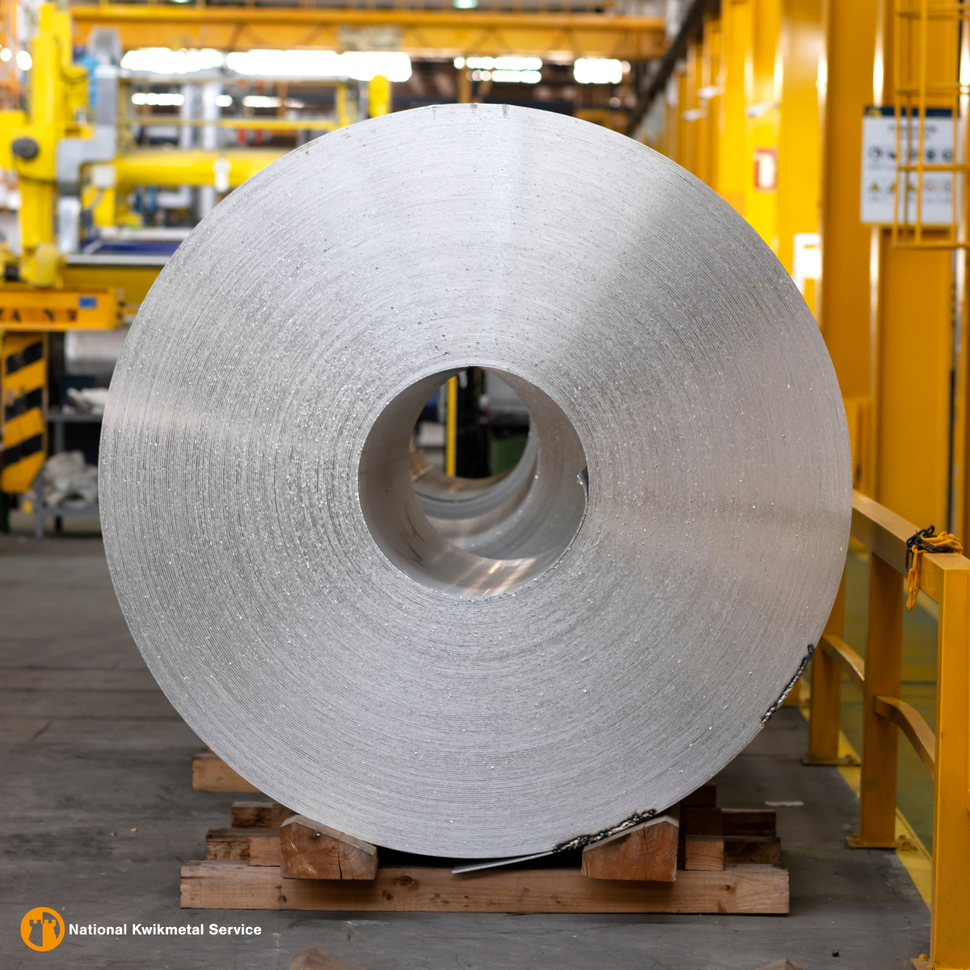
Why Automotive Aluminum Coil Needs to Arrive at the Right Width
High-volume automotive manufacturing depends on repeatability. Presses, dies, feeding equipment and production schedules are designed around defined material inputs, and coil dimensions are part of that equation.
That makes the width of aluminum coil for automotive manufacturing more than a purchasing specification.
It is a production parameter.
NKS supplies and processes precision-slit aluminum coil for automotive manufacturing programs, preparing material for stamping, forming and continuous-production environments.
Coil Width Should Match the Manufacturing Process
A stamping operation requires material that works with the tooling and component geometry for which the line was designed.
When incoming coil is unnecessarily wide, manufacturers may be paying for material that does not contribute to the finished component. When width is wrong for the tooling or feed system, the issue becomes operational rather than merely financial.
Precision slitting converts master-coil material into narrower widths according to a customer’s production requirements.
For automotive manufacturers, the objective is to align those widths with tooling, process and finished-component demands.
NKS’s November social campaign emphasizes exactly that relationship: high-volume automotive production requires coil widths that correspond with the process, tooling and final component requirements.
Aluminum Is Not Stainless Steel
Experienced coil processing matters because different metals do not behave identically during slitting.
The November NKS campaign specifically notes that aluminum behaves differently from stainless during coil processing.
That means processing strategy should reflect the actual material being handled rather than assuming a single approach is appropriate for every coil product.
For buyers, this is another reason to define the complete aluminum requirement when requesting a quote.
Alloy and temper matter alongside gauge and finished width.
Precision Slitting Supports Continuous Production
Automotive manufacturing rarely treats each stamped component as an isolated job. Production lines are designed to repeat operations efficiently across significant volumes.
Incoming material needs to support that model.
Precision-slit coil can be prepared to fit the width requirements of stamping and forming operations, helping reduce unnecessary handling between raw-material receipt and production.
For recurring automotive programs, buyers should also consider required coil weights and production-release patterns rather than focusing only on price per unit of material.
NKS specifically asks customers to communicate alloy, temper, thickness, slit width and coil-weight requirements when requesting an automotive aluminum quote.
Build the Coil Specification Around the Press
A productive aluminum-coil RFQ should reflect how material will actually be consumed.
Provide:
That gives the processor greater visibility into the downstream production requirement.
Put the Right Coil Width into Your Automotive Line
Automotive productivity begins well before the first press stroke. Material dimensions need to align with the equipment designed to consume them.
If your automotive stamping program requires aluminum coil prepared around a specific tool or production line, send NKS the alloy, temper, thickness, slit width and coil-weight requirements. Request an automotive aluminum coil quote from NKS: https://nks.com/locations/request-a-quote/
Phone: 847-257-6570
Phone: +52.442.644.5979
Phone: 615-793-4700